Marketing data platforms unify customer data across channels and enable teams to deliver targeted, timely messages to drive growth. Choosing the right platform determines how fast you can act on customer signals, how well your channels work together, and how much effort you spend maintaining messaging infrastructure.
This guide examines the top 7 solutions, breaking down their key features, strengths, and ideal use cases to help you make an informed decision.
The top 7 marketing data platforms at a glance
- Knock. Best for teams that need cross-channel messaging infrastructure with power and control across product, engineering, growth, and operations.
- Segment. Best for teams building a centralized customer data pipeline to route events to downstream tools.
- Braze. Best for large enterprise marketing teams running large-scale cross-channel campaigns.
- Customer.io. Best for product-led companies that want event-driven messaging with a visual workflow builder.
- Iterable. Best for B2C marketers who need comprehensive experimentation across channels.
- HubSpot Marketing Hub. Best for small to mid-market teams that want marketing automation bundled with CRM.
- OneSignal. Best for mobile-first teams that need a straightforward push notification and messaging layer.
What is a marketing data platform?
A marketing data platform collects, organizes, and activates customer data so teams can send the right message to the right person at the right time. These platforms connect data sources (product events, user attributes, behavioral signals) with messaging channels (email, push, SMS, in-app, chat) to power personalized communication at scale. The best platforms go beyond data collection by providing the orchestration, preference management, and delivery infrastructure needed to turn raw data into meaningful customer interactions.
How to evaluate marketing data platforms
When evaluating marketing data platforms, look for solutions that meet these criteria:
- Cross-channel orchestration. The platform should coordinate messaging across email, push, SMS, in-app, and chat from a single workflow, not require separate tools for each channel.
- Data flexibility and integration. It should connect with your existing data sources (CDPs, data warehouses, product events) and adapt to your data model rather than forcing a rigid schema.
- Team collaboration. Engineering, product, growth, and operations teams all touch messaging. The platform should give technical teams the API-first control they need while providing visual tooling that enables non-technical stakeholders to manage templates, preferences, and workflows.
- Scalability and reliability. Look for enterprise-grade infrastructure with uptime SLAs, automatic scaling, and delivery guarantees that hold up at high volume.
- Transparent pricing. Messaging costs can grow fast. Predictable pricing tied to actual usage (messages sent, not data points consumed or opaque credit systems) helps teams plan and scale without surprises.
Based on these criteria, we've shortlisted 7 solutions.
Knock
Overview
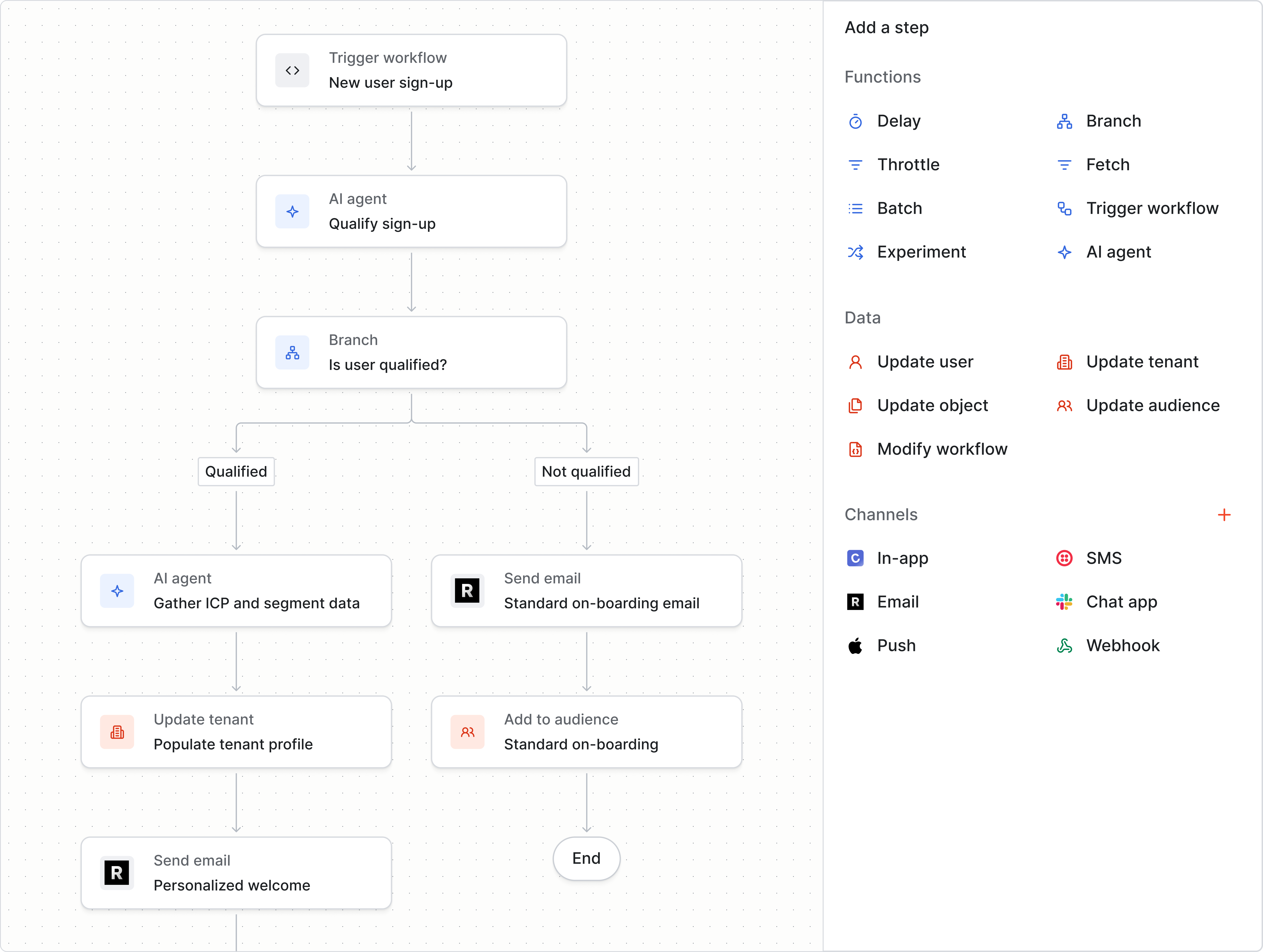
Knock is a customer engagement infrastructure platform that powers cross-channel messaging for product and growth teams. It provides a unified API, visual workflow builder, and pre-built UI components that enable teams to ship messaging as fast as they can build it. Engineering, product, growth, and operations teams collaborate within a single platform to manage the full customer communication lifecycle.
Best for
Knock is purpose-built for when multiple teams need to collaborate on messaging. Engineering gets API-first infrastructure, product can trigger workflows based on product usage, growth gets intelligent lifecycle messaging, and operations gets unparalleled visibility into delivery and engagement. It provides the technical control and feature breadth that developers will love, alongside visual tooling that empowers non-technical team members.
Strengths
- All-in-one, cross-channel messaging. Knock handles in-app messaging, email, push, SMS, Slack, and webhooks from a single platform with intelligent routing, batching, and preference management built in. Teams manage one system instead of stitching together multiple point solutions.
- AI-native platform. Knock helps teams move faster with AI embedded directly into the platform. Prompt agents to create messaging workflows, build and personalize templates, and manage audiences. Agents can also systematically enrich data, add complex targeting logic, and personalize messaging in real time, so teams ship higher-quality messaging with less manual work.
- Cross-team collaboration without bottlenecks. Product managers and marketers iterate on templates, workflows, and broadcasts through the dashboard without waiting on engineering. Developers retain full version control and API access, eliminating the back-and-forth that slows messaging at most companies.
- Built-in analytics and observability. Cross-channel engagement tracking, delivery logs, and the ability to stream data to warehouses and Datadog give every team visibility into messaging performance without building custom analytics infrastructure.
- Developer experience and speed to production. A clean API, SDKs for every major language, CLI tooling, environment management, and pre-built React components let engineering teams ship notification infrastructure in days. Plus, Knock is the only customer engagement platform you can work with from Cursor or Claude Code.
Limitations
- Learning curve for less technical teams. Knock's infrastructure-first approach provides depth and flexibility, which means teams benefit most when they invest time in understanding concepts like workflows, channels, and tenancy.
Pricing
Knock offers a free Developer plan with up to 10,000 messages per month. The Starter plan is $250/month with 50,000 messages included and $0.005 per additional message. Enterprise plans offer volume-based discounts, monthly notified user pricing, HIPAA compliance, SAML SSO, and dedicated support. Knock charges only for messages sent, not for workflow triggers, and does not bill for failed or bounced messages.
How it compares
Unlike traditional marketing automation tools that focus on campaign management for marketing teams, Knock provides the underlying infrastructure that powers all customer communication. Where platforms like Braze and Iterable are built for marketers running campaigns, Knock gives engineering, product, and growth teams shared control over every message in the system, from transactional alerts to lifecycle campaigns to in-app experiences.
Segment
Overview
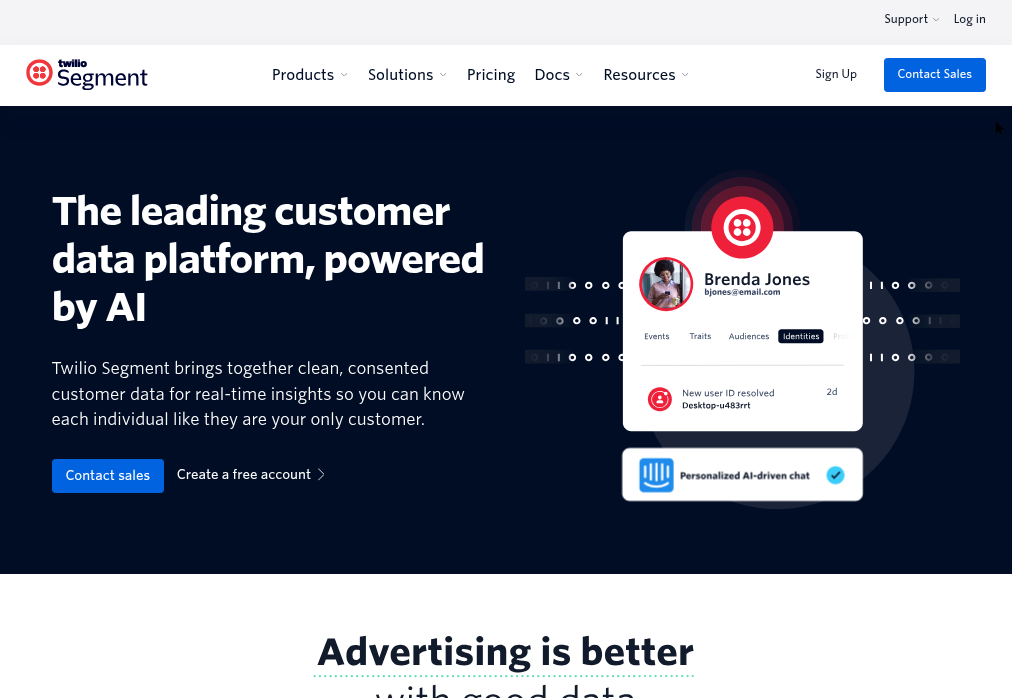
Segment is a customer data platform (CDP) that collects events from websites and apps, cleans and unifies that data, and routes it to hundreds of downstream tools through a single API.
Best for
Organizations that need a centralized data layer to feed multiple marketing, analytics, and engagement tools. Segment is useful when your tech stack spans many vendors and you want to implement tracking once rather than per tool.
Strengths
- Single API for data collection. Implement one tracking library and send data to over 400 integrations without writing custom code for each destination.
- Identity resolution. Segment stitches together anonymous and known user activity across devices into unified profiles, which improves personalization across your stack.
- Flexible data routing. Transform and route data to different destinations based on custom rules, enabling teams to control which tools receive which events.
Limitations
- Not a messaging platform. Segment collects and routes data but does not send messages. You still need a separate tool for email, push, SMS, and in-app delivery.
- Complexity for smaller teams. Segment's full value emerges when you have a multi-tool stack and engineering resources to configure routing rules and transformations.
Pricing
Free tier for up to 1,000 monthly tracked users. Team plan starts at $120/month with usage-based scaling. Business plans offer custom pricing with advanced features like data governance and identity resolution.
How it compares
Segment and Knock serve complementary roles. Segment collects and routes your customer data; Knock acts on that data by orchestrating and delivering messages across channels. Many teams use Segment as a data source that feeds into Knock's workflow engine. If you need both data infrastructure and messaging infrastructure, using them together covers both layers.
Braze
Overview
Braze is an enterprise customer engagement platform that powers cross-channel messaging for large consumer brands. It supports email, push, SMS, in-app messages, WhatsApp, and content cards, all orchestrated through Canvas, its visual journey builder.
Best for
Enterprise marketing teams at consumer-facing companies with large user bases that need real-time personalization and sophisticated campaign orchestration. Braze is built for marketers running campaigns, not for engineering or product teams managing transactional and product-triggered messaging.
Strengths
- Advanced campaign orchestration. Canvas, Braze's journey builder, supports multi-step, branching campaigns with AI-powered send-time optimization and predictive analytics.
- Mobile-first capabilities. Braze has strong support for mobile push, in-app messaging, and content cards, making it a natural fit for apps with large mobile audiences.
- Scale and reliability. The platform processes billions of data points daily and serves brands like HBO and Burger King.
Limitations
- Opaque pricing. Braze does not publish pricing. Costs are structured around monthly active users (MAU), data points consumed, and flexible message credits. Data point pricing can be difficult to predict. Entry-level paid plans typically start around $30,000 to $60,000 annually.
- Marketing-team focus. Braze is designed for marketers, not engineering or product teams. Developers who need API-first infrastructure with version control, CLI access, and environment management will find the platform less flexible.
- Complex onboarding. Implementation timelines for Braze are measured in weeks or months, and the platform requires dedicated resources to manage effectively.
Pricing
Custom pricing based on MAU, data points, and message credits. No public pricing page. Enterprise contracts typically start at $30,000+ annually.
How it compares
Braze is a strong choice for enterprise marketing teams that need campaign orchestration at scale. Knock differs in that it serves as shared infrastructure across engineering, product, growth, and operations, not just the marketing team. Knock's API-first approach, developer tooling, and transparent pricing make it a better fit for teams where technical and non-technical stakeholders collaborate on messaging.
Customer.io
Overview
Customer.io is a customer engagement platform that enables teams to create event-driven messaging workflows across email, SMS, push, and in-app channels.
Best for
Product-led SaaS companies that want a visual workflow builder for behavior-triggered messaging without deep engineering involvement. Customer.io bridges the gap between marketing automation and product messaging for teams that operate primarily through a dashboard.
Strengths
- Event-driven workflow builder. The visual builder makes it straightforward to create behavior-triggered campaigns with branching logic, delays, and A/B testing.
- Flexible data model. Customer.io accepts custom attributes and events without requiring a rigid schema, which gives teams more freedom in how they structure their data.
Limitations
- No pre-built in-app components. Customer.io supports in-app messaging but does not provide production-ready UI components like notification feeds or toasts. Teams need to build their own front-end layer.
- Weaker multi-team collaboration. The platform is designed primarily for marketing and product teams. It lacks the granular access controls, audit logs, and cross-team workflow management that engineering-led organizations need.
- Limited developer tooling. Customer.io is dashboard-first. Engineering teams that want API-first infrastructure, CLI access, environment management, and version-controlled workflows will find the platform restrictive.
Pricing
Essentials plan starts at $100/month for up to 5,000 profiles. Premium plans offer advanced features at higher price points. Enterprise pricing is custom.
How it compares
Customer.io is a solid choice for product-led teams that want a visual, dashboard-first approach to messaging. Knock provides deeper infrastructure, from API and CLI tooling to pre-built in-app components to multi-tenant support, that makes it a better fit for organizations where engineering, product, and growth teams all need to collaborate on messaging at a systems level.
Iterable
Overview
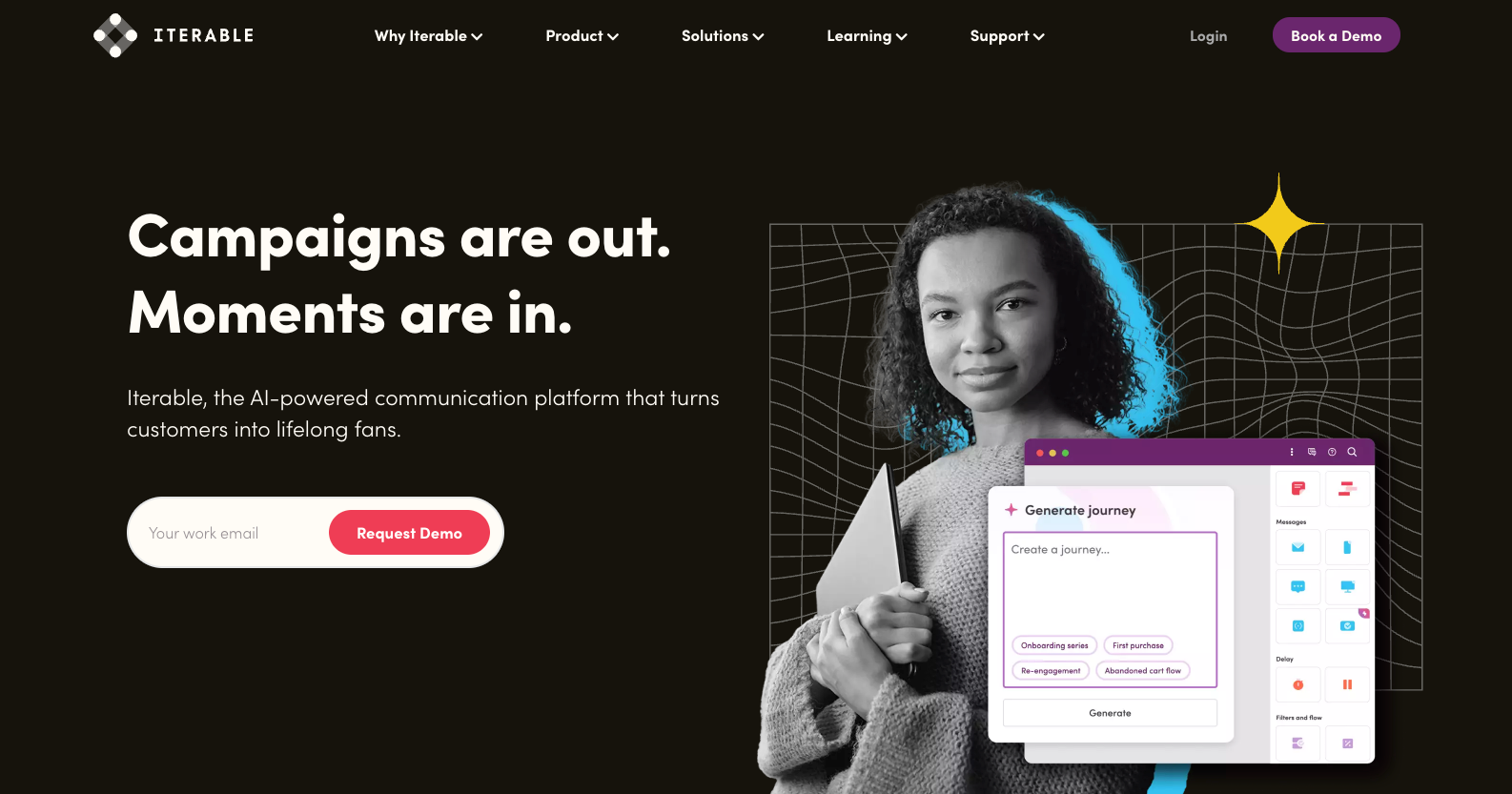
Iterable is a cross-channel marketing platform that uses AI to help B2C marketers personalize messaging across email, SMS, push, and in-app channels at scale.
Best for
Mid-market to enterprise B2C companies in e-commerce, media, and delivery that need AI-driven campaign optimization and audience segmentation. Iterable is designed for marketing teams that want to run sophisticated multi-channel campaigns.
Strengths
- AI-powered optimization. Iterable AI automates send-time optimization, audience creation, and content personalization based on behavioral data.
- Workflow Studio. The drag-and-drop campaign builder supports complex multi-step journeys with branching, delays, and conditional logic.
- Strong email capabilities. Advanced template management, A/B testing, and deliverability tooling make Iterable a strong choice for email-heavy programs.
Limitations
- B2C and marketing focus. Iterable is built for marketing teams at consumer companies. Engineering and product teams that need infrastructure-level control over transactional and product messaging will find it limited.
- Opaque pricing. Iterable does not publish pricing and uses a modular model based on channels and volume. Contracts require sales conversations.
- Rigid data model. Like Braze, Iterable enforces strict data types for all fields, which can make it difficult to manage messy or evolving data structures.
Pricing
Custom pricing based on channels, message volume, and features. No public pricing page. Contact sales for a quote.
How it compares
Iterable is a solid marketing automation platform for B2C teams. Knock takes a different approach as shared infrastructure that serves every team involved in customer communication. Where Iterable works for marketers, Knock provides developer-grade control with visual tooling to enable product and growth teams to manage messaging independently.
HubSpot Marketing Hub
Overview
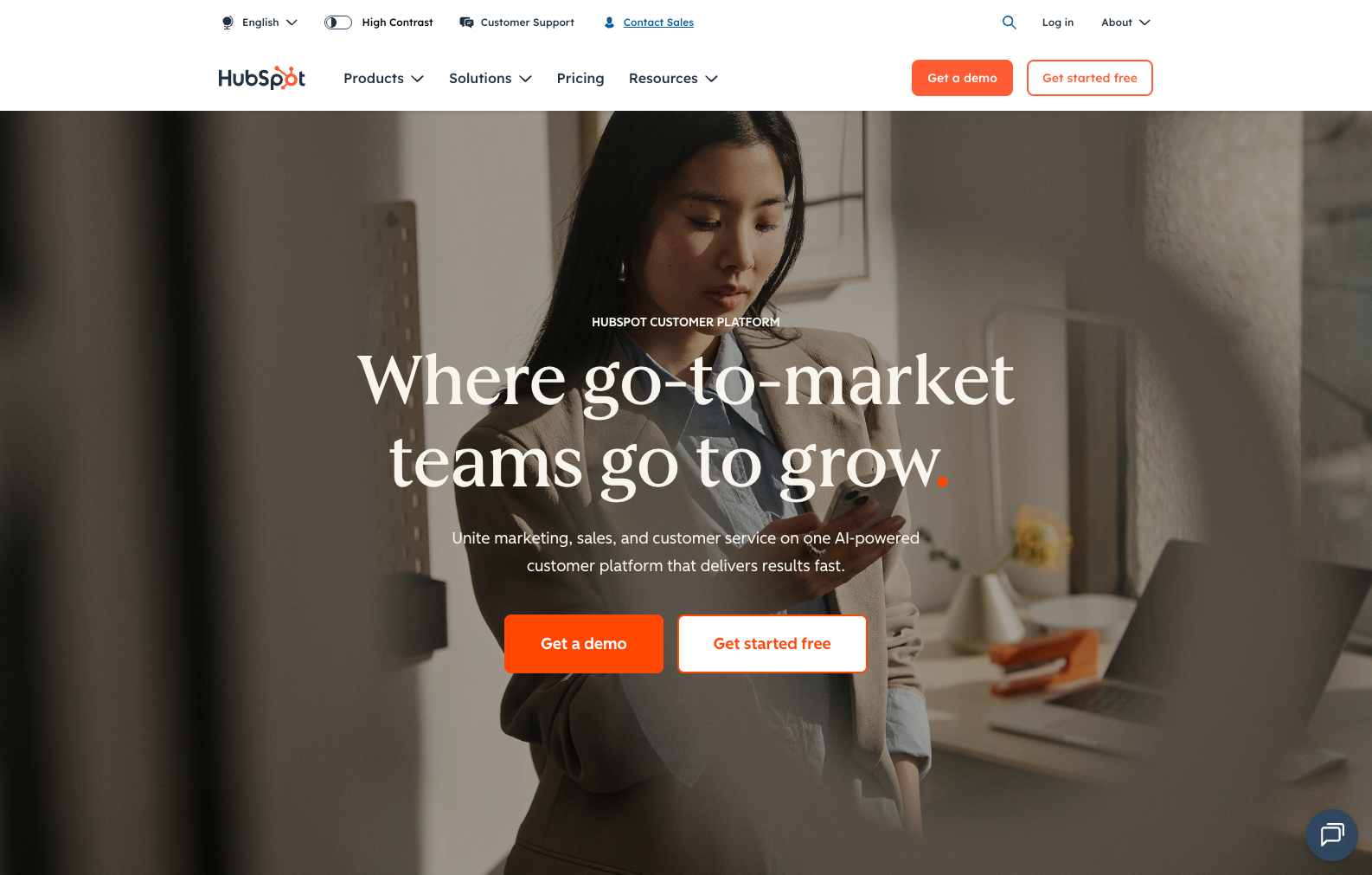
HubSpot Marketing Hub is a marketing platform that combines email marketing, landing pages, social media management, and analytics with HubSpot's CRM.
Best for
Small to mid-market teams that want marketing automation bundled with CRM in a single ecosystem. HubSpot works well for teams that prioritize ease of use and want to manage marketing campaigns alongside sales and service workflows.
Strengths
- Integrated CRM and marketing. HubSpot's native CRM integration means marketing, sales, and service teams share a single view of customer data without third-party connectors.
- Ease of use. The platform is designed for non-technical users, with drag-and-drop editors, pre-built templates, and guided workflows.
- Broad feature set. Email marketing, landing pages, forms, social scheduling, SEO tools, and reporting are included in a single subscription.
Limitations
- Limited technical depth. HubSpot is not built for engineering-led workflows. There is no API-first notification infrastructure, no CLI tooling, and limited support for transactional messaging patterns like batching, throttling, or multi-tenant delivery.
- Expensive at scale. HubSpot's pricing increases steeply with contact volume and feature tier. The Professional plan starts at $800/month, and Enterprise starts at $3,600/month.
- Channel gaps. HubSpot lacks native support for in-app messaging, push notifications, and real-time messaging channels like Slack, which limits its usefulness for product-driven communication.
Pricing
Free tools available. Starter plan begins at $20/month. Professional starts at $800/month. Enterprise starts at $3,600/month. Pricing scales with contact volume.
How it compares
HubSpot is a good choice for go-to-market teams at small to mid-market companies that want an all-in-one platform. Knock provides messaging infrastructure that engineering, product, and growth teams use together to power every type of customer communication. Teams that need transactional messaging, in-app messaging, or cross-team collaboration on messaging workflows will find Knock a better fit.
OneSignal
Overview
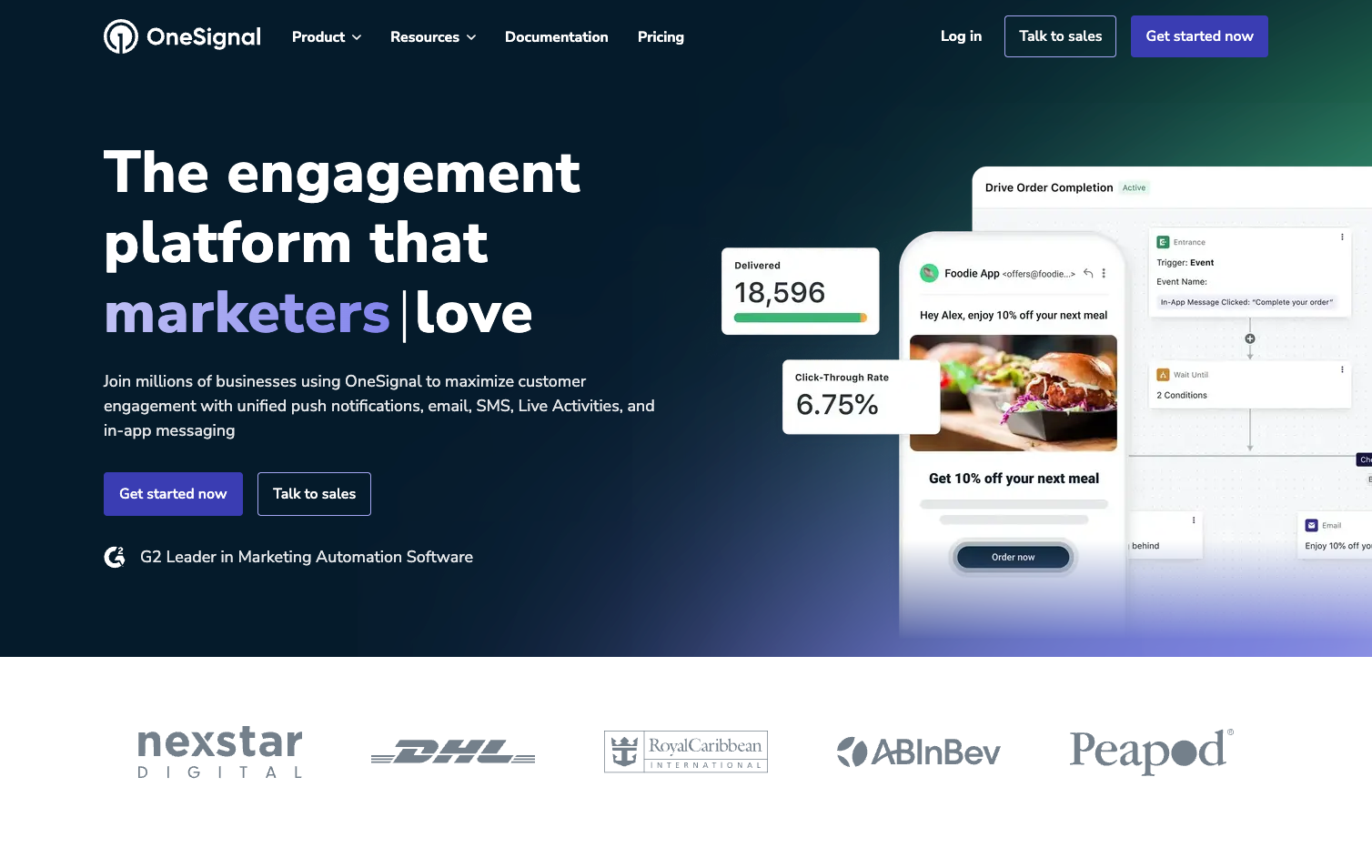
OneSignal is a messaging platform focused on push notifications, with support for email, SMS, and in-app messaging. They offer a strong free tier that makes it accessible for smaller teams and mobile-first products.
Best for
Mobile-first teams and smaller companies that need a straightforward, affordable way to add push notifications and basic messaging to their product. OneSignal is a practical starting point for teams with limited budgets and simpler messaging requirements.
Strengths
- Generous free tier. OneSignal's free plan supports up to 10,000 email subscribers and unlimited mobile push, making it one of the most accessible entry points for messaging.
- Quick setup. SDKs and documentation are designed for fast integration, and most teams can start sending push notifications within a day.
- Audience segmentation. Built-in segmentation based on user properties, tags, and behavior enables targeted messaging without external tooling.
Limitations
- Limited workflow orchestration. OneSignal provides basic automation (like drip campaigns) but lacks the multi-step, conditional workflow capabilities of platforms like Knock or Customer.io.
- No in-app notification feed. OneSignal supports in-app pop-ups but does not offer a persistent notification feed component, which limits its usefulness for product-driven communication patterns.
- Fewer integrations. The platform has a smaller integration ecosystem compared to Segment, Braze, or Knock, which can require more custom development for complex stacks.
Pricing
Free plan with generous limits. Growth plan starts at $9/month. Professional plan starts at $99/month. Enterprise pricing is custom.
How it compares
OneSignal is a practical, budget-friendly option for teams that need basic push and messaging. Knock provides a more complete infrastructure layer, with cross-channel orchestration, pre-built in-app components, multi-tenant support, and API-first tooling designed for teams that need messaging to scale as their product grows.
How to choose the right marketing data platform
Small teams
Knock provides the fastest path to production with a free plan, pre-built components, and an API that gets teams from zero to live notifications in a day. OneSignal is another option for teams with basic push notification needs and tight budgets.
Enterprise
For enterprise organizations where multiple teams (engineering, product, growth, and operations) need to collaborate on messaging, Knock provides the technical control developers require with visual, low-code tooling to empower non-technical stakeholders. Braze is an alternative for enterprises where marketing is the primary team driving messaging and budget is less of a concern.
Technical teams
Knock and Customer.io provide API-first infrastructure designed for engineering workflows. Knock goes further with CLI tooling, environment management, version control, and the ability to work directly from Cursor or Claude Code, making it the stronger choice for developer-led teams.
Non-technical teams
HubSpot and Customer.io balance basic marketing capabilities with ease of use. Both platforms offer visual builders and pre-built templates that enable marketers to create and manage campaigns without engineering support.
Budget-constrained
Knock and OneSignal offer predictable pricing that scales reasonably with growth. Knock's Starter plan at $250/month with 50,000 messages included, and OneSignal's free tier, provide clear paths for teams that need to manage costs while growing.
Compliance-heavy
Knock and Braze provide enterprise-grade security, SOC 2 compliance, and data residency options. Knock also supports HIPAA compliance with signed BAAs on its Enterprise plan, making it a strong option for healthcare and regulated industries.
Marketing data platform FAQs
Can a marketing data platform replace my existing messaging infrastructure?
Some can. Platforms like Knock are designed to replace custom-built notification systems. Teams that switch to Knock typically reduce engineering time spent on messaging infrastructure by moving from months of maintenance to a managed service, while gaining cross-channel orchestration, preference management, and analytics they didn't have before.
Do I need separate tools for transactional and marketing messages?
Only Knock supports both transactional messages (like password resets and billing alerts) and lifecycle messages (like onboarding sequences and feature announcements) within a single platform. This eliminates the need to manage separate systems for different message types.
How do marketing data platforms handle user preferences?
Knock provides built-in preference management that gives users control over which channels and messaging types they receive, at both the user and tenant level. This is managed through the API or dashboard and respects preferences automatically at delivery time, reducing unsubscribes and improving engagement.
What's the difference between a CDP and a marketing data platform?
A CDP like Segment focuses on collecting, cleaning, and routing data. A marketing data platform goes further by acting on that data to orchestrate and deliver messages. Knock functions as the activation layer where customer data becomes customer communication, and integrates with CDPs like Segment and reverse ETL tools like Hightouch and Census.
How long does it take to implement a marketing data platform?
Implementation timelines vary. With Knock, teams routinely go from integration to production in days, thanks to clean APIs, comprehensive SDKs, and pre-built UI components. Enterprise platforms like Braze typically require weeks or months to fully implement.
Activate customer data with Knock
Your customer data is only valuable when you act on it. Knock gives engineering, product, growth, and operations teams the infrastructure to turn customer events into timely, relevant messages across every channel, from in-app messaging and email to push, SMS, and Slack.
Create your free Knock account to get started, or talk to our team to learn how Knock can power your messaging at scale.